Time: August 19, 2026 — August 20, 2026
Location: Room 77201, Jingchunyuan 78, BICMR
 Speakers, Lectures & Schedule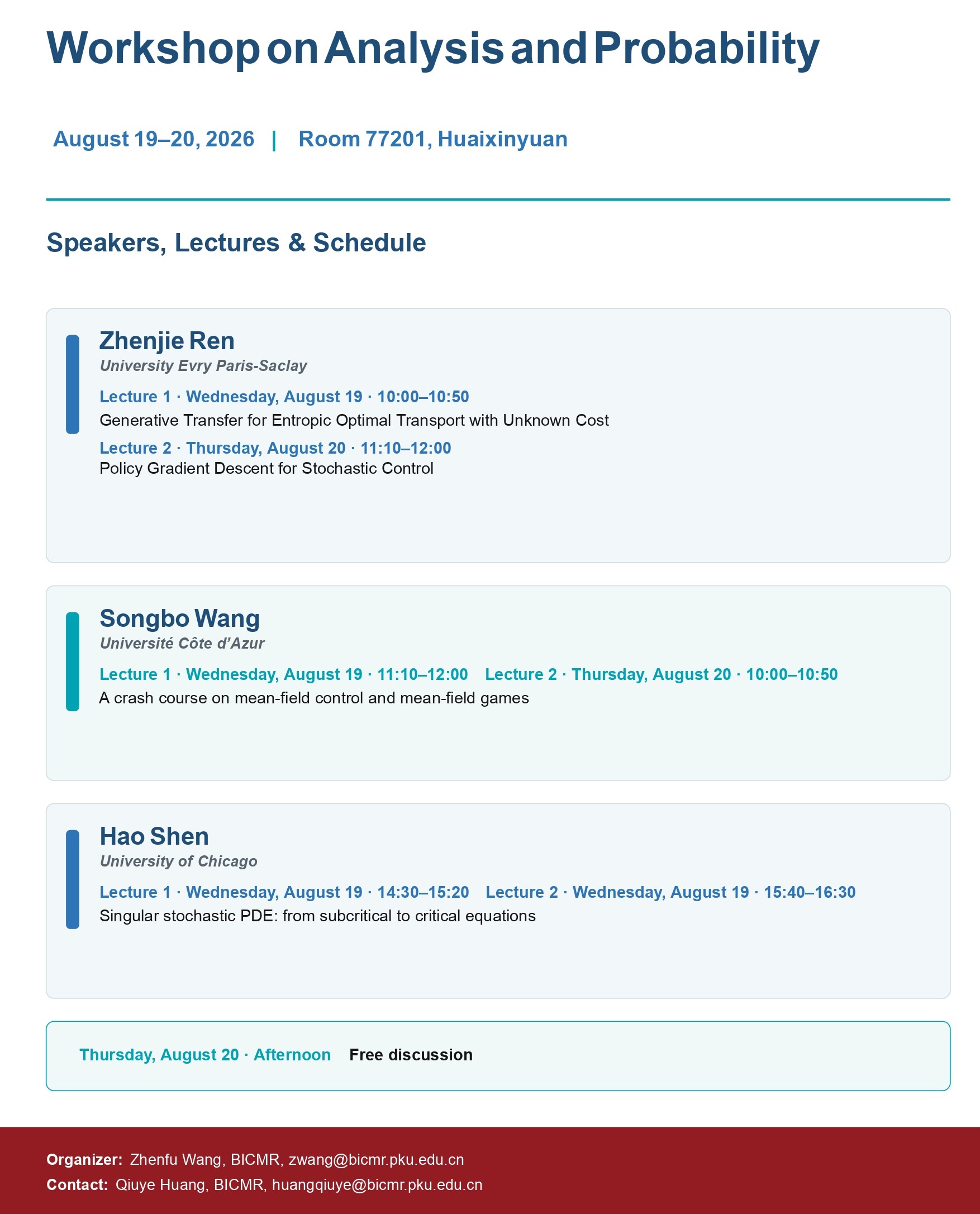
 List of SpeakersTalk information
 Zhenjie Ren's talks:
Lecture 1:
Title: Generative Transfer for Entropic Optimal Transport with Unknown Cost
Abstract: In many applications of entropic optimal transport, the transportation cost is unknown and cannot be specified a priori. In this talk, we present a strategy to address this challenge in a particular setting. We aim to transport a distribution (\mu) to (\nu), and we assume access to samples from a coupling between (\mu') and (\nu') that is optimal for the same unknown cost. Leveraging flow matching and structural properties of entropic optimal transport, we develop an algorithm that transfers this information to learn the corresponding Schrödinger bridge between (\mu) and (\nu).
Lecture 2:
Title: Policy Gradient Descent for Stochastic Control
Abstract: Reinforcement learning has achieved remarkable success in landmark applications such as AlphaGo and AlphaFold, and is increasingly expected to play a central role in emerging domains such as autonomous driving. A substantial body of work has established theoretical foundations for classical reinforcement learning algorithms, including temporal-difference learning, policy iteration, and Q-learning. By contrast, policy gradient descent, despite its widespread use, remains less well understood from a theoretical perspective, largely because of its non-convex structure and the complexity of the underlying functional space. Existing convergence analyses typically require uniform regularity assumptions on the policy, viewed as a feedback control function, along the gradient flow; moreover, the resulting convergence rates depend on these regularity bounds. In this work, we significantly strengthen the existing convergence theory. Our key insight is to relate policy gradient descent to a mirror flow on the space of probability measures over controlled trajectories, where the Bregman divergence is induced by the convex control cost. We rigorously prove a JKO-type convergence result showing that the discrete-time mirror flow converges to its continuous-time counterpart, and we identify the limiting dynamics as a preconditioned policy gradient descent flow on the space of control processes. Leveraging this mirror-flow perspective, we establish an exponential convergence rate that is independent of policy regularity. The convergence holds both in Bregman divergence and in the value of the associated control problem.
Hao Shen's talks:
Lecture 1 & 2:
Title:Singular stochastic PDE: from subcritical to critical equations
Abstract:In the theory of SPDE, the past decade has seen remarkable progress in constructing local solutions for subcritical equations, such as the 1D KPZ equation, the 3D Phi4 model and Yang-Mills model, thanks to the development of regularity structures and paracontrolled calculus. However, tackling critical SPDEs in general remains one of the premier open challenges in the field. Unlike subcritical equations, critical SPDEs exhibit scale invariance and lack smoothing at high iterations, requiring infinitely many renormalization terms and overcoming combinatorial challenges in high-order expansions. I will review some recent developments on 2D KPZ equation, and then discuss our new result on the 4D Anderson model in the weak coupling regime. We believe that the analytical and combinatorial machinery developed in this work would establish a blueprint for addressing more complex nonlinear critical SPDEs in future works at least in small coupling regimes. Based on joint work with Yu Deng.
Songbo Wang's talks:
Lecture 1 & 2:
Please scan the QR code or click the link below to access the conference handbook.

Contact:
Ms. Qiuye Huang
Tel: 010-62744120
E-mail:huangqiuye@bicmr.pku.edu.cn

